- Fourth straight year of near double-digit increases for U.S. employers
- Employers now absorb more than 80% of health plan costs as rising expenses increasingly impact workforce and business planning decisions
- The average employee is expected to spend nearly $5,300 on health care in 2026, reflecting continued pressure on household budgets
CHICAGO, Aug. 20, 2026 /PRNewswire/ -- Aon plc (NYSE: AON), a leading global professional services firm, revealed today that U.S. employer health care costs are projected to rise 9.5%* in 2027, pushing average costs above $19,000 per employee.
This projection marks the fourth consecutive year of elevated health care cost trends approaching double digits, extending one of the most sustained periods of health care inflation employers have faced in decades.
Medical spending continues to rise as utilization of health care services increases, chronic conditions become more prevalent and the numbers of high-cost claims grow. Prescription drug spending also remains a significant contributor, driven by growing use of specialty medications and continued adoption of GLP-1 therapies. As these treatments expand into new clinical areas such as cardiovascular disease, sleep apnea and chronic kidney disease as emerging oral formulations broaden access and treatment options, employers are facing increasing pressure to balance access, affordability and long-term sustainability.
Additional cost pressure is emerging as providers adopt technologies, including AI, that support more detailed clinical documentation and coding, contributing to higher billed charges in some instances.
"Employers have now experienced several consecutive years of health care cost increases that are approaching double digits," said Mike Pasterick, North America Health Solutions Leader for Aon. "At this level, rising health care costs become much more than a budgeting challenge and influence organizational decisions from benefits strategy and employee affordability to broader workforce and financial planning priorities. Leaders are undergoing pressure to maintain affordable benefits while continuing to invest in attracting, supporting and retaining talent."
The Growing Cost Burden on Employers and Employees
Although health care costs are projected to increase 9.5% in 2027 before mitigation efforts, employers routinely implement plan design changes and cost-management strategies to help offset a portion of those increases.
The chart detailing Annual Changes to Total Cost of Care reflects actual employer and employee health care costs in 2026 after those actions were taken, providing a view of how rising costs are ultimately shared between employers and employees.
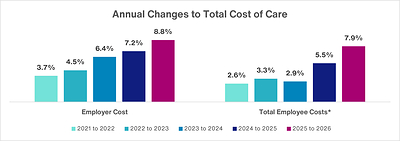
Even after implementing measures to manage costs, employers continue to absorb most of the increase. Employer health care cost increases have more than doubled since 2022, rising from 3.7% to 8.8% in 2026. On average, employers are responsible for about 82% of the plan cost, reflecting ongoing efforts to limit the financial impact on employees.
Plan Cost | 2025 | 2026 | Change from |
Employer Cost | $13,269 | $14,432 | 8.8 % |
Employee Premiums from Paycheck | $2,943 | $3,130 | 6.4 % |
Total Plan Cost** | $16,212 | $17,562 | 8.3 % |
Employer Subsidy | 81.8 % | 82.2 % | 0.4 % |
While average plan costs increased 8.3%, the average tells only part of the story. The middle 50% of employers experienced increases ranging from 5.5% to 11.5%, demonstrating the wide variation in cost pressures organizations are facing.
Employee Costs*** | 2025 | 2026 | Change from |
Employee Premiums from Paycheck | $2,943 | $3,130 | 6.4 % |
Employee Out-of-Pocket Costs | $1,966 | $2,167 | 10.2 % |
Total Employee Costs | $4,909 | $5,297 | 7.9 % |
Employees are also facing growing affordability pressures. In 2026, employees are expected to pay an average of $5,297 for health care coverage, including both payroll contributions ($3,130) and out-of-pocket expenses ($2,167). The increase in out-of-pocket costs can be attributed to the increased utilization of health care services, as well as the enrolment in leaner plan options.
Health Care Inflation Remains a Cross-Industry Challenge
Cost pressures are affecting employers across every sector; all industries experienced significant growth in plan costs from 2025 to 2026. Average employer cost increases ranged from 6.5% to 9.8% across the industries, while total plan cost increases exceed 6% across the board.
Additionally, across all industries, employee contribution increases remained below overall employer and total plan cost increases, indicating that many organizations continue to absorb a significant share of rising health care expense.
Projected 2025 to 2026 Increase | Employer | Employee | Total Plan Cost |
Manufacturing | 7.5 % | 5.3 % | 7.1 % |
Professional Services | 8.7 % | 3.5 % | 7.5 % |
Finance and Insurance | 9.8 % | 4.7 % | 8.8 % |
Health Care | 6.5 % | 5.3 % | 6.3 % |
Retail and Wholesale Trade | 7.7 % | 6.6 % | 7.5 % |
Public Sector | 8.8 % | 7.7 % | 8.6 % |
Technology and Communications | 9.1 % | 6.4 % | 8.6 % |
Looking Ahead: Navigating a New Era of Health Care Costs
Employers are expected to face continued pressure from rising medical utilization, chronic disease prevalence and growth in drug spending. As these cost drivers evolve, organizations are increasingly focused on strategies that improve health outcomes, enhance the employee experience and address the underlying drivers of spending to manage long-term affordability for both employers and employees.
"The organizations best positioned for the future will be those that can proactively identify emerging risks and take targeted action before costs escalate," said Debbie Ashford, North America Chief Actuary, Health Solutions for Aon. "Health care costs are becoming increasingly difficult to manage through traditional approaches alone. Employers will need better data and deeper insights to understand where costs are rising and how they can make more informed decisions about their health care investments."
To support these efforts, employers are increasingly turning to data and analytics tools that provide greater visibility into network performance, utilization patterns and cost drivers. Solutions such as Aon's Network Analyzer help organizations evaluate potential strategies, improve value and make more informed decisions about long-term health care affordability.
Aon's Health Value Initiative
The historical information and projections shown above were developed using Aon's Health Value Initiative database, which captures health care costs and benefit designs for more than 1,100 U.S. employers representing 7.9 million employees and $135 billion in 2026 health care spend. The projections above are developed after taking plan design changes as well as demographic and geographic population adjustments into account.
To learn more about Aon's Health Solutions, visit https://www.aon.com/home/solutions/health.
* The projection is applicable in a status quo environment when employers do not make changes or implement care management programs. Aon consultants expect many employers to implement cost-saving changes or programs to help mitigate this increase.
** Total plan costs represent the employer's and employee's combined premiums for medical and prescription drug costs but exclude employee out-of-pocket payments such as deductibles, co-pays and co-insurance.
*** Based on the weighted average cost of employers in Aon's analysis in both 2025 and 2026.
About Aon
Aon plc (NYSE: AON) exists to shape decisions for the better — to protect and enrich the lives of people around the world. Through actionable analytic insight, globally integrated Risk Capital and Human Capital expertise, and locally relevant solutions, our colleagues provide clients in over 120 countries with the clarity and confidence to make better risk and people decisions that help protect and grow their businesses.
Follow Aon on LinkedIn, X, Facebook and Instagram. Stay up-to-date by visiting Aon's newsroom and sign up for news alerts here.
Media Contact
Haley Robinson
+1 312 381 0159
haley.robinson@aon.com
Disclaimer
The information contained in this document is solely for information purposes, for general guidance only and is not intended to address the circumstances of any particular individual or entity. Although Aon endeavors to provide accurate and timely information and uses sources that it considers reliable, the firm does not warrant, represent or guarantee the accuracy, adequacy, completeness or fitness for any purpose of any content of this document and can accept no liability for any loss incurred in any way by any person who may rely on it. There can be no guarantee that the information contained in this document will remain accurate as on the date it is received or that it will continue to be accurate in the future. No individual or entity should make decisions or act based solely on the information contained herein without appropriate professional advice and targeted research.
SOURCE Aon plc
Access international media contacts, the full library of Aon media releases, and a media kit with fact sheet and executive bios, via links below.